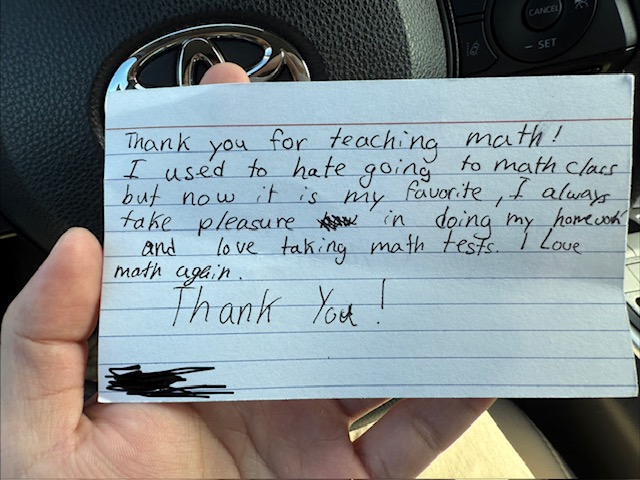
As teachers, there is nothing better than knowing our students have become middle and high school math teachers. But as a parent who who also taught her children high school math, knowing that one of them is in the classroom daily encouraging students to become more confident mathematicians is something I never thought I’d experience. Our eldest is an introvert and artist-type and our younger son is all about history. 2025-2026 brought a surprise — It is our eldest son’s first year teaching math and coincidentally my last (full) year teaching math. As a parent of an adult child, we experience long periods of times when they don’t need our help. So, when the text or phone call comes in, we pounce on it like a lioness taking down an antelope.
There are three things for which he seeks my advice:
- Classroom management. With a degree in computer science and minors in math and art, he had no formal training on how to handle challenging students and situations. Truth be told, even those who come out of an education program have no real training on it either. When you are alone in your classroom with your students, you have be quick on your feet and no one is there to intervene. Building relationships with students, having routines, and finding what motivates each student goes a long way to maintaining a productive learning environment. If you’re doing all of these things and still have those challenging students, reaching out to the parent sometimes works, but with teens… not always. When that fails, I always reach out to a coach or elective teacher to gain some insight. Sometimes that solves the problem. If not, I reach out to an assistant principal.
- Editing Assessments About one per week I receive a text, “I’ll be sending you a test soon.” What this means is I’ll be getting either an Algebra 2 or a Geometry test in its second draft. My job is to go through it and make sure the directions are clear, the spacing is good (so the students have enough room to work and the teacher has as easy a time as possible grading), the problems are not redundant and the difficulty level variety is good. I also work the key at the same time and give suggestions of points-per-problem to assign. His need for me to help in this way has tapered off but he made good use of me in September, October and November!
- Gimmicks Before teaching factoring quadratic trinomials where the leading coefficient is not 1, my son watched an accompanying curriculum video. This video used a gimmick, which is a way I rarely teach, especially as I have gained more experience. This was the time the text came in and when I didn’t answer it in 5 seconds, he called. After a little bit of time on the phone I realized I needed to watch the curriculum video and then zoom with my son. His main issue was where the extra leading coefficient was going. I looked at this video and we went through a bunch of problems together over zoom and I couldn’t really figure out the gimmick either. But it was really bothering him. So, he kept thinking about it all night (by the way he was prepping for a few days in advance so there wasn’t too much panic) and had that light bulb moment. He knew he didn’t need to teach factoring in the same way as the curriculum videos, but he wanted to be ready in case a student asked him about it. SO PROUD!
Oh, and I also get texts from him with links to my TpT store when he wants a PDF of a circuit. LOL. Early on he was searching the internet for an activity to do with inequalities and this was the first hit. He had to text me and let me know.
That’s all for now, I’ll leave you with a picture of an index card thank you note I received around the same time.
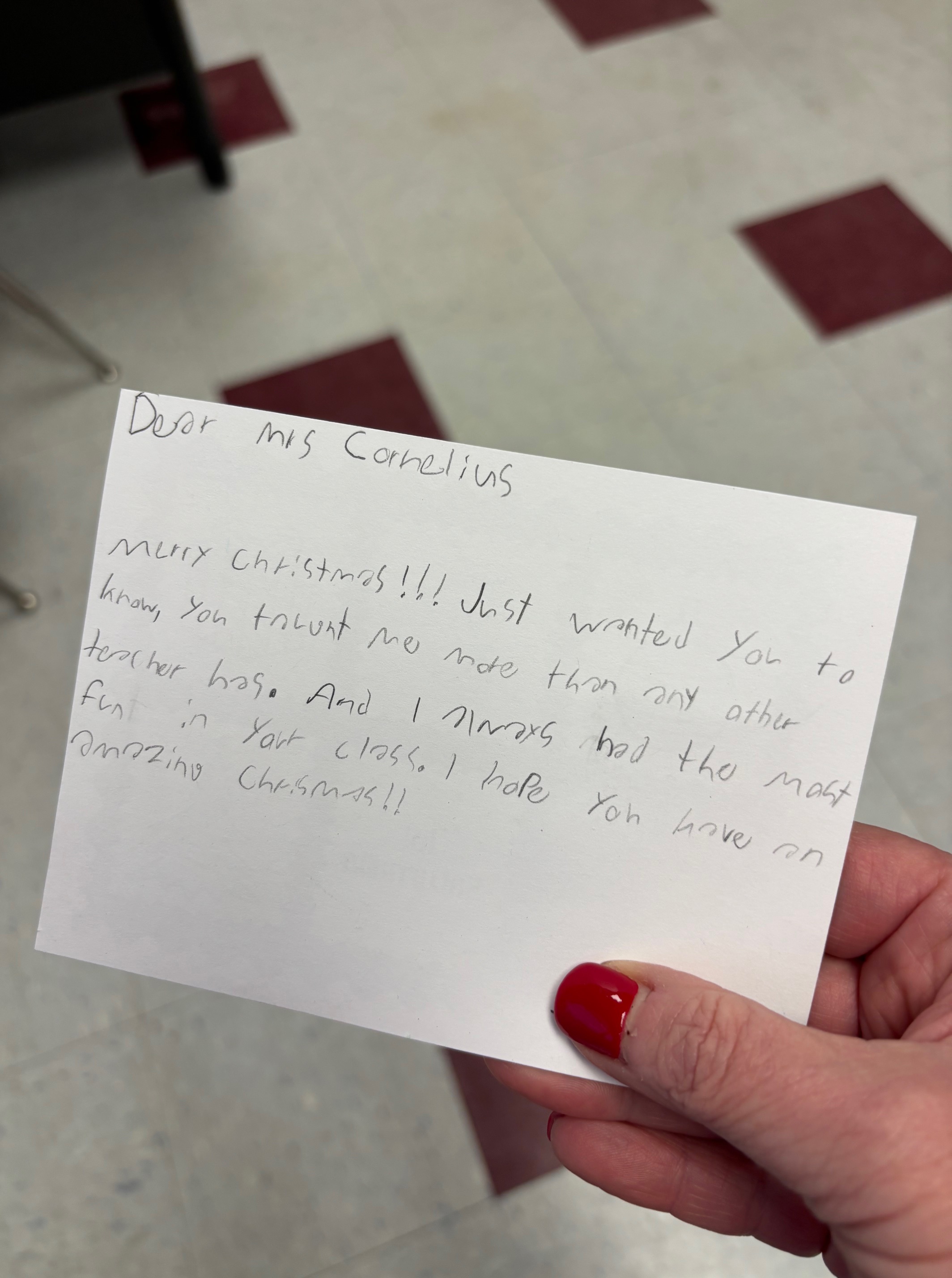
Translation: Merry Christmas! Just wanted you to know, you taught me more than any other teacher has. And I always had the most fun in your class. I hope you have an amazing Christmas!
 Math, Teaching, and Teaching Math